
PATENT & DEVELOPMENT

From Patent to Prototype

The patented Maximum Delivery architecture provides a foundation for the MDE platform. Establishing practical system performance is the next engineering task.

HISTORICAL EVIDENCE

From Early Geometry to a Functional Architecture

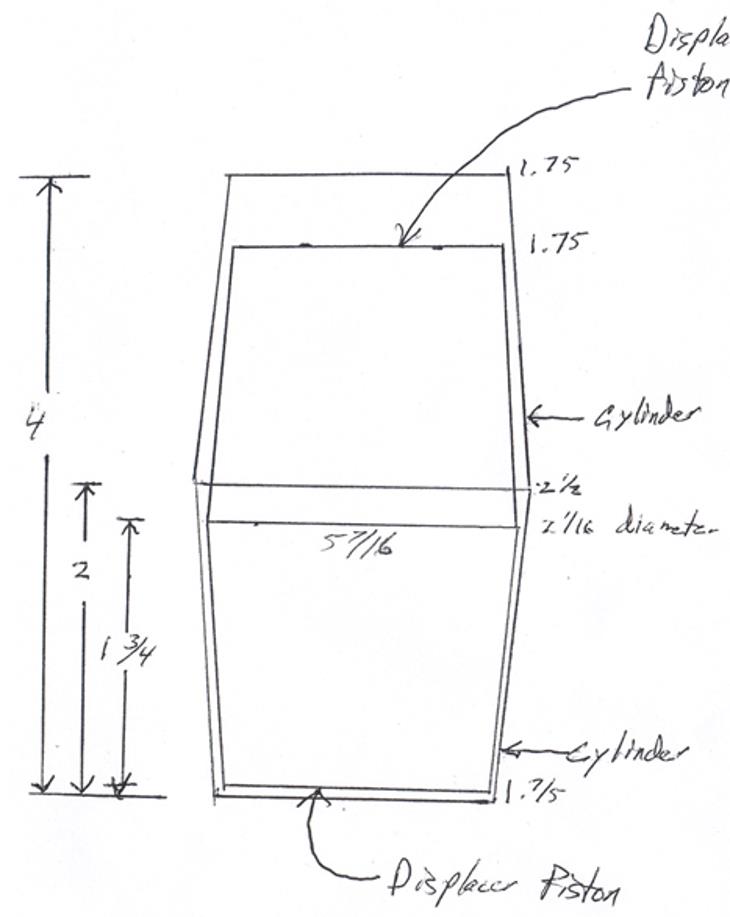
January 25, 2008 — Earliest Surviving Sketch

Original handwritten sketch showing an early tapered chamber and displacer concept.

January 25, 2008. The sketch records the early tapered/frustum geometry before years of later refinement.

View original sketch (PDF)

2010 — Partial Proof of Concept

The original model ran at 855 rpm; the modified frustum model ran at 999 rpm, a 16.8% increase in measured speed. Later reconstruction showed approximately 26.6% lower maximum working-fluid volume.

The hot-cap region could be elongated to increase heat-transfer surface area without requiring a proportional increase in working-fluid volume or conventional dead volume.

“More heat-transfer area without paying for it with more dead volume.”

Torque was not measured, so the test did not establish increased shaft power. This partial proof of concept did not validate electrical output, efficiency, durability, manufacturability, or full-scale performance.

November 2014 — Deliberate Adiabatic Operation / No-Regenerator Direction

By November 2014, the development record clearly shows deliberate use of adiabatic compression and expansion and the conclusion that the engine should operate without a conventional regenerator.

March 2024 — Common Space + Midpoint Thermal Communication

The March 2024 provisional patent application described the common-space architecture and thermal communication between the power-piston cylinder and the chamber at or near the chamber midpoint / maximum-diameter region. This was the principal architecture and patent-value milestone.

This relationship allows the working fluid to communicate thermally with the power piston from the chamber’s central region, rather than requiring the heated working fluid to first travel through the opposite thermal end.

Further development centered on deliberate adiabatic compression and expansion, isochoric heating and cooling, and the low-dead-volume concept.

March 25, 2025 — U.S. Nonprovisional Filed

June 9, 2026 — U.S. Patent No. 12,650,097 B1 Issued

U.S. Patent No. 12,650,097 B1
“Maximum Delivery Adiabatic Hot-Air Engine”

PATENTED TECHNOLOGY

Patented in the United States

Read the issued U.S. patent (PDF)
U.S. Patent number
12,650,097 B1
Title
Maximum Delivery Adiabatic Hot-Air Engine
U.S. nonprovisional application filed
March 25, 2025
Issued
June 9, 2026

INTELLECTUAL PROPERTY

International Patent Application

The PCT international patent application is published.

Read published PCT application (PDF)
PCT application number
PCT/US2026/020310
International filing date
March 23, 2026
Published
October 1, 2026
Publication No.
WO 2026/206813 A1
Title
Maximum Delivery Adiabatic Hot-Air Engine

CURRENT ENGINEERING

Analysis Before Physical Validation

HHES is using thermodynamic analysis, heat-transfer and flow modeling, and CFD/OpenFOAM simulation to evaluate MDE designs before prototype fabrication. Instrumented hardware testing will then establish actual performance.

HHES is evaluating smaller mobile-scale, larger residential/small-business, and educational MDE designs.

Prototype configuration and sequencing will be selected based on engineering results, fabrication practicality, and development priorities.

DEVELOPMENT STATUS

Engineering, testing, and measured results.

Patent issuance establishes intellectual-property rights. Commercial performance, durability, efficiency, emissions, manufacturability, and economics will be established through continued engineering analysis and prototype testing.

CONTACT

Follow the Development of HHES

HHES welcomes technical, strategic, manufacturing, and investor interest in the development of its technology.

Contact information